
The Talbot Oration: Our Ocean, Our Lifeline
The ocean sustains all life on Earth, yet we know remarkably little about it. In the sixth annual Talbot Oration, Terry Garcia explores the threats, the solutions, and the pathways to protect it.
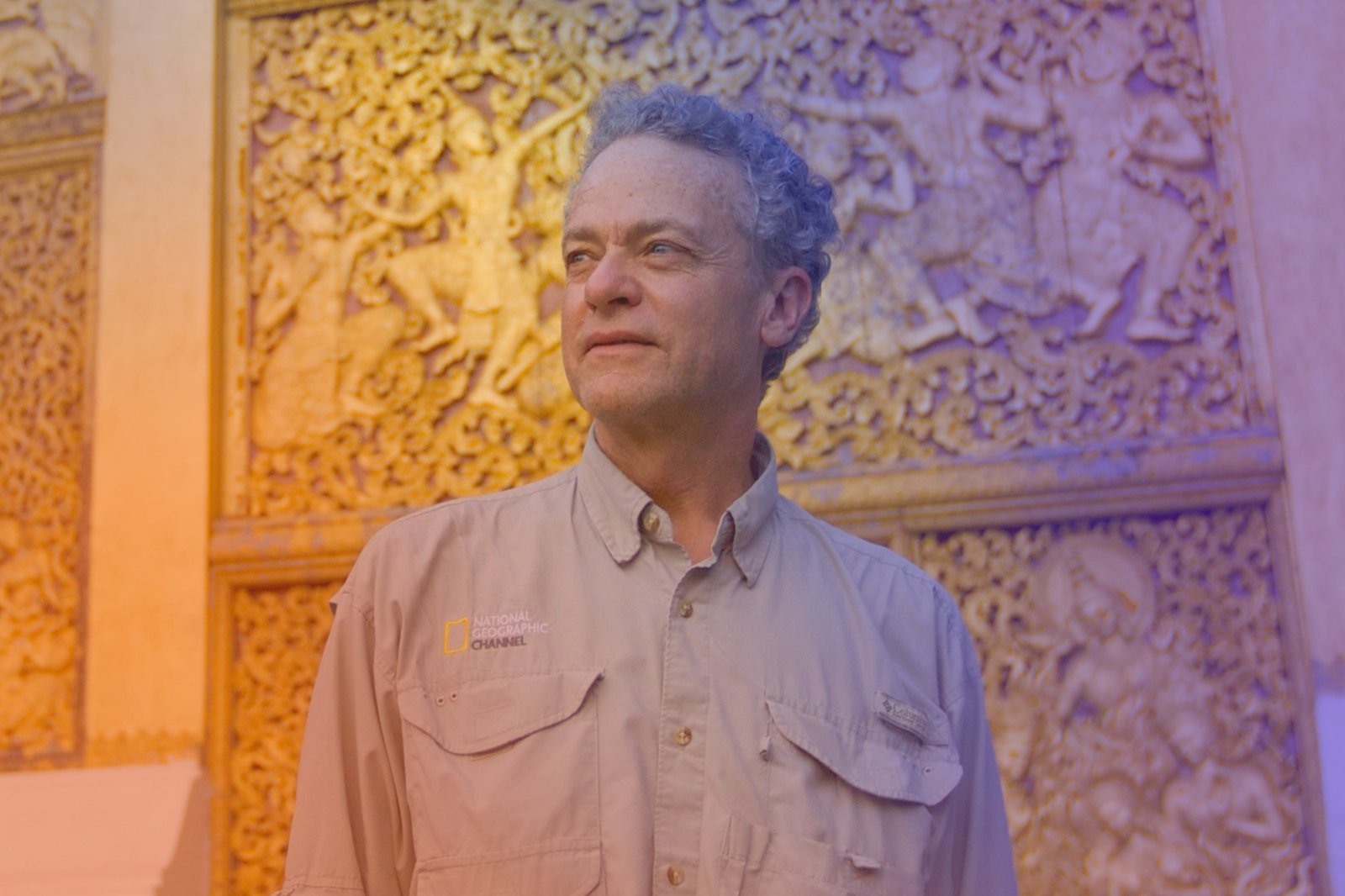
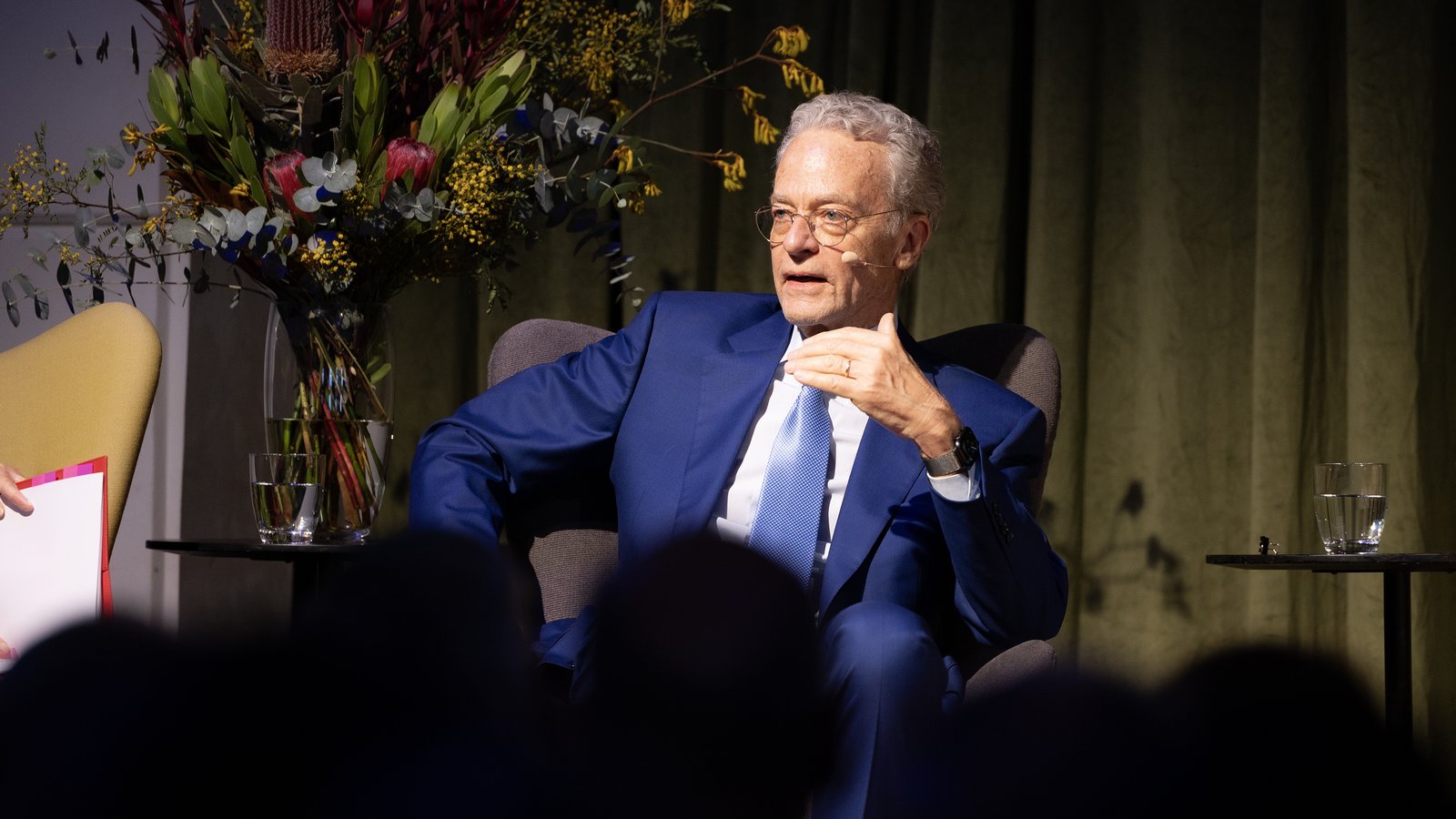
© Terry Garcia
Over the course of my career, I have had the privilege of looking at the ocean (and environmental issues more generally) from three different vantage points — from government, from exploration, and from storytelling.
Each perspective offered unique insights into ocean challenges which I’ll share with you. I’ll also offer my thoughts on the policies of the current administration in Washington and their impact on the ocean and the global frameworks that protect it. Terry Garcia
Watch the Talbot Oration: Our Ocean, Our Lifeline
I’ve always been drawn to the ocean. It captures my imagination in ways that few other things do. And while people tend to associate outer space most often with exploration, the truth is that some of the greatest unexplored regions lie not above us but beneath us — at the bottom of the ocean.
My friend Bob Ballard, who found the Titanic, says that children sometimes come up to him and ask him to stop exploring, because there won’t be anything left for them. He has to tell them he has barely scratched the surface.
He’s right. And what is most exciting is that new technologies — autonomous platforms, satellite remote sensing, environmental DNA, machine learning — are revolutionizing exploration. I believe the 21st century will be the greatest age of exploration in the history of humankind.
One of the exploration initiatives I launched when I was at National Geographic — and the one I am perhaps most proud of — is the Pristine Seas project. Our objective was to go to the last truly wild places left in the ocean, to survey and understand them, and to bring attention and, where possible, protection to some of the last intact natural wonders we have.
These expeditions have confirmed that the ecological and economic benefits of keeping such places intact far outweigh the short-term gains from exploiting them.
Over the last decade, the project has helped protect 6.9 million square kilometers of ocean — an area roughly twice the size of India.
Its objective is the creation of 50 marine no-take areas by 2030.
One of the early expeditions was to an uninhabited chain of islands in the South Pacific.
Specifically, Millenium Atoll.
It’s about as middle-of-nowhere as it gets.
It was a rare chance to see what the ocean should look like.
And its indescribably beautiful—although I’ll try and describe.
This is Millennium Atoll.
The water is so clear there, it is as if you are looking through air.
There are corals in every color, shape, and size.
And in a sign of a healthy, balanced ecosystem, large predators dominated. On every dive, we were surrounded by dozens of sharks, enormous grouper, and snapper.
And it was magnificent.
It ruined me for diving anywhere else.
An experience like makes you want to share it with others and help them understand why its so critical we protect it.
I share this story tonight because I believe Professor Frank Talbot understood that truth better than almost anyone.
As Director of this Museum and founder of the Lizard Island Research Station, Dr. Talbot devoted his life to revealing the ocean’s wonders — and he was passionate about the need to protect the marine environment.
Tonight I want to talk about what the ocean means to us, how we are putting it at risk and what we can do about it.
Because the story of the ocean in the twenty-first century is not yet written.
And we — everyone in this room — will help write it.
The Need
I’m going to start with a simple framework that explains why the ocean matters to everyone on Earth — whether you live on the coast or a thousand miles from the sea.
First, we need the ocean to breathe.
Take a breath.
Now take another.
The oxygen in the first came from trees and green plants on land.
The oxygen in the second came from the ocean.
The ocean produces roughly half of the oxygen we breathe. Every second breath you take, thank the ocean.
Second, we need the ocean to eat.
40% of the world’s population depends on the ocean for a significant portion of its protein. In many developing countries, that share is far higher.
Third, we need the ocean to regulate our climate.
Its currents determine weather patterns across the globe, and its waters absorb over 90 % of the extra heat now being trapped in our atmosphere due to climate change.
Fourth, we need the ocean to understand our world.
Its waters may hold roughly a million species — we don’t really know, because we have explored so little of it. They carry the secrets of the inner-workings of our planet, of how life began, of how it can survive in the harshest of circumstances.
Fifth, we need the ocean to sustain the global economy.
If the ocean were an economy, it would rank among the largest in the world. Ocean-based industries generate trillions of dollars in value and support livelihoods for billions of people. The marine economy reps 9% if Australia’s GDP and supports over 700,000 jobs.
And sixth, we need the ocean to tell the human story.
There is more human history beneath the surface of the ocean than in all the museums on land.
Ancient civilizations. Thousands of shipwrecks.
Time capsules of human endeavor waiting to be discovered.
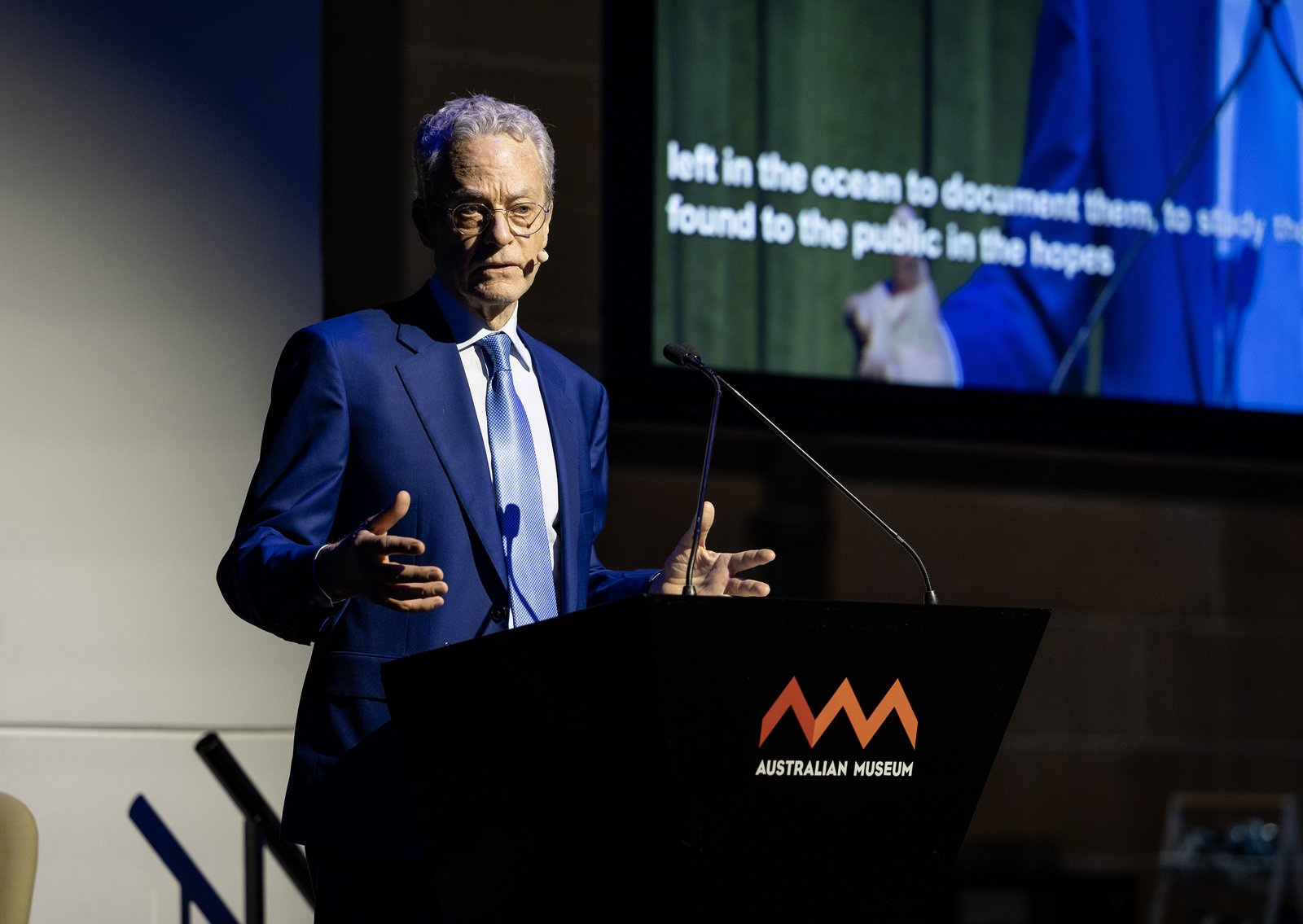
© Australian Museum
The Problem
There is one more thing we urgently need: more people to understand what is at stake. Because right now, the ocean is at risk.
The problem is simply stated: We are taking out all of the things we like — and putting in all of the things we do not.
Let’s start with what we are taking out.
Overfishing and destructive industrial fishing are draining the life out of our seas.
According to the FAO’s latest global assessment, 35% of fish stocks are now overfished — depleted faster than they can recover.
Disturbingly, it is estimated that up to 20% of the global fish catch is the result of illegal fishing.
To make matters worse, each year governments spend $22 billion on harmful fish subsidies that encourage fleets to fish farther, longer, and harder than the ocean can sustain. We’re funding a race to the bottom.
We have already removed much of the ocean’s great abundance — the largest predators, the lions and tigers of the sea.
And when we deplete the top of the food chain, we destabilize everything below it.
A newer concern is seabed mining.
An emerging industry is now targeting minerals on the ocean floor that are seen as valuable for everything from renewable energy to consumer electronics to defense systems.
But mining the deep seabed could destroy habitats we barely understand. We don’t know how these fragile systems would respond to large-scale disturbance.
That is a dangerous place from which to make irreversible decisions.
And yet that is exactly where we are.
Pollution
Meanwhile, we are putting everything we do not like into the ocean.
The ocean is downstream from everything.
Every river, every drain, every exhaust pipe eventually leads to the sea.
80% of ocean pollution comes from land-based sources: oil, pesticides, sewage, plastic, and urban and agricultural runoff.
Excessive nutrient loading causes explosive growth of algae and the depletion of oxygen, resulting in toxic algal blooms and dead zones
There are now hundreds of these dead zones around the world where little marine life can survive.
In some places, we are pushing the ocean back toward a much earlier biological age — one in which the ocean was ruled by jellyfish and bacteria.
And then there is plastic.
The ocean is now being suffocated by what some scientists call a plastic smog — a vast and growing cloud of debris and microplastics that stretches from coastlines to the deepest points in the ocean.
The equivalent of roughly one garbage truck of plastic enters the ocean every minute.
Plastics are consumed by wildlife and enter a food chain that—remember—ends with us. We have precious little understanding of the long-term human health consequences.
Without major intervention, that flow could multiply in the decades ahead.
Finally, there is climate change.
The twin crises of ocean degradation and climate change are inextricably intertwined.
As US Secretary of State, John Kerry put it: “You can’t protect the ocean without solving the problem of climate change, and we can’t solve climate change without protecting the ocean.”
Since the Industrial Revolution, we have done the unthinkable.
We have changed the very chemistry of the ocean.
By absorbing our carbon emissions, the ocean has become roughly 30 percent more acidic than it was at the dawn of the industrial age. (and that change is happening faster than any point in the last 300 million years).
That harms corals and shell-forming organisms, with consequences for fisheries, tourism, and coastal protection.
The ocean also acts as the planet’s heat sink, absorbing over 90 percent of the excess heat trapped in the climate system by our greenhouse gas emissions.
We are now seeing the consequences in real time.
Sea-surface temperatures have hit record highs.
And right now, we are living through the most widespread coral bleaching event ever recorded. Since 2023, roughly 84 % of the world’s reefs have experienced bleaching-level heat stress.
My old agency, NOAA, has had to add three new alert levels to its coral bleaching scale—the equivalent of adding Category 6 and 7 to the hurricane scale, because the existing categories couldn't capture what we're seeing.
The Great Barrier Reef, has experienced repeated mass bleaching, including another major event in 2025—the 6th since 2016. At the very place Professor Talbot pioneered his research, Lizard Island, a 2025 study revealed an unprecedented 92.0% coral mortality rate following the 2024 global bleaching event
For coral reefs, rising temperature and rising acidity are a devastating one- two punch.
The ocean is not just suffering from climate change.
It is transmitting climate risk into human lives, communities, and economies.
Warmer oceans also help drive more intense storms, heavier rainfall, greater flooding, and super charging El Nino events.
The ocean is also central to any solution. It is the planet’s largest active carbon sink.
However, its ability to help us depends on the health of its living systems.
Seagrasses, mangroves, and salt marshes capture and store carbon at at rates far higher per hectare than tropical forests.
Phytoplankton — microscopic organisms operating at planetary scale — capture enormous quantities of carbon dioxide.
As do other species. Whales, for example, help circulate nutrients and stimulate productivity-- part of the complex biological machinery that moves carbon through the ocean.
But overfishing, increasing carbon emissions and destruction of coastal ecosystems are weakening the ocean’s ability to mitigate climate change.
The more the climate changes, the more the ocean is damaged.
And the more the ocean is damaged, the harder it becomes to address climate change.
We’ve created a dangerous feedback loop.
A Path Forward
So, that is the bad news.
And I apologize if hearing it all at once makes you want to leave now and find a bar.
But there is good news as well.
The first piece of good news is that one of the ocean’s defining traits is resilience. With a little help, it can recover.
And second, we do not need a miracle.
We will need smart policy, innovative technology, private-sector engagement, and bold exploration.
Policy
Every day, societies solve complex problems by agreeing on rules that protect the common good.
The ocean is no different. We know what works.
We can eliminate harmful fisheries subsidies.
We can end destructive fishing practices.
We can establish marine protected areas in the places that matter most.
These are not theoretical solutions. They are proven tools.
Marine Protected Areas don’t just conserve biodiversity. They rebuild fish populations, restore ecosystems, and make the entire system more resilient.
And the world is starting to act.
Last year, the World Trade Organization’s Agreement on Fisheries Subsidies entered into force. It is the first WTO treaty focused on environmental sustainability, and it calls for the elimination of the harmful subsidies I mentioned earlier. However, it is best viewed as a first step, and subsequent negotiations are needed for a more comprehensive ban on subsidies..
Earlier this year, the UN High Seas Treaty entered into force. It is the first legally binding framework to protect biodiversity in the two-thirds of the ocean beyond any nation’s jurisdiction. This treaty provides the critical legal mechanism needed to establish marine protected areas in international waters.
Under the Global Biodiversity Framework, the world’s nations have committed to protecting 30% of the ocean by 2030. We have now officially crossed the 10% mark. If we simply redirected the $22 billion in harmful fisheries subsidies we could cover all or most of the annual cost of managing a network of MPAs that would achieve the 30% protection goal.
Because plastic pollution has become a planetary problem, governments have begun, for the first time, negotiating a global plastics treaty.
Progress has been frustratingly slow, but at least work has begun.
This is probably the right moment to address the elephant in the room.
The country I served — twice, under two presidents — has, over the past year, walked away from much of what it built. The current administration withdrew from the Paris Agreement. It has made deep cuts to NOAA, including major climate and ocean research programs. Last year it fast-tracked deep sea mining — even in international waters, bypassing the International Seabed Authority. And recent Supreme Court decisions, have hobbled our ability to regulate activities that contribute to climate change. To name a few.
These actions could have far-reaching consequences, measured in harm to reefs, coastlines, fisheries, and the well-being of people around the world.
The challenges we face require urgent action, but the sad truth is that, for at least the next 2.5 years, the global community cannot count on the United States to be a reliable leader or partner on ocean and climate policy.
If progress is to be made, others will have to shoulder the burden. In that regard, Australia and the Asia-Pacific region have the credibility, institutions, and scientific capacity this moment urgently requires.
Australia is perfectly positioned to assert international leadership given its role as President of the 2026 UN climate summit (COP31) in November.
Technology
We are in the midst of an explosive growth in new technologies. We are only beginning to apply the power of these new technologies to the ocean.
But as we do, the impact could be transformative.
A growing range of public and private monitoring systems and autonomous vehicles are giving us near real-time visibility across vast stretches of the ocean-- for tracking fishing activity, identifying suspicious behavior, and monitoring ocean conditions at scale.
AI allows us to process data — to identify species, detect patterns, and predict changes --at a speed and volume unimaginable a few years ago.
And new biotechnologies hold the promise of strengthening efforts to bolster the ocean's resilience. For example, Australia has been a leader in assisted evolution to help coral systems adapt to rising temperatures. (though probably not a cure, but may buy us time).
But policy and technology alone won't get us there. We also need capital — and not just more of it, but capital structured in fundamentally different ways.
Capital (BLUE NATURAL CAPITAL)
Imagine a stretch of coastline in Southeast Asia. The mangroves were cleared for shrimp farms. The shrimp farms collapsed. The fishing village now lands half the catch it once did. The reefs are degraded. And every cyclone season, the local port spends millions repairing storm damage the mangroves and reefs used to absorb for free.
Now ask: who fixes that?
Not the shrimp farmer — he's gone. Not the fisherman — he can't afford to. Not the port — it sees only its own balance sheet. Not the government — it has dozens of coastlines like this one.
That coastline is broken in a way no single actor has the incentive to repair.
And it is a typical scenario. Why?
One big reason: we have never truly measured what healthy ecosystems provide.
Mangroves, reefs, and seagrass meadows aren’t just nice scenery; they are vital infrastructure — buffering storms, sustaining fisheries, storing carbon, protecting coastal communities. But because that value is invisible in our accounting, ocean protection has suffered from a chronic shortage of capital.
The gap is enormous. Recent analysis from the Ocean Panel estimates that current financial flows fall short by roughly $550 billion a year of what's needed to secure long-term ocean health.
Philanthropy can’t fill it. Government can’t fill it.
The Private Sector and Private capital must be part of the solution — not to replace public leadership, but to scale and accelerate it.
And just as critical, we need to redirect capital away from activities that degrade the ocean — harmful fisheries subsidies, for example — and toward those that restore resilience and long-term value.
The shift required is one of mindset. Ocean recovery is not only a cost. It is an investment — in systems that reduce losses, in businesses that generate revenue, and in technologies that solve real problems.
Capital can play three distinct roles.
First: repair broken systems.
Return to that coastal town.
Restoring the mangroves and reef would cost millions. But if those natural systems come back: the hotels face less flood and erosion risk. The port loses fewer operating days. The public sector spends less on roads, seawalls, and storm damage. The fishing community sees nursery habitat — and catch — recover.
The problem is that no single actor captures all the benefits, so no one wants to shoulder the full cost. One emerging answer is the "beneficiary-pays" model — or s0-called “Payments for Ecosystem Services”.
Imagine a platform — a public trust, a sovereign-owned enterprise, or a development-finance partner — that helps finance the restoration up front, organizes the beneficiaries, and creates a payment mechanism to maintain these natural buffers.
By doing this, we begin to turn an invisible public benefit into something that can be measured, financed, and sustained.
If structured properly, each party pays less than the losses they would otherwise face from continued degradation.
This is still an emerging model. Much of today's work in blue finance is about building the plumbing — mechanisms to aggregate projects, pool capital, blend public and private funding, and reduce risk to investable levels.
Philanthropic and government dollars typically act as catalytic, capital — taking the riskiest first position so that private investors can participate on more acceptable terms.
Some financial tools are being tested on the ground, including blue bonds and certain insurance products.
In Quintana Roo, Mexico, for example, a coastal trust funded by hotel associations, state government, and philanthropic partners purchases parametric insurance on the reef. Instead of waiting months for damage assessments, the policy pays out automatically when a storm reaches a predefined wind-speed threshold. That means money is available quickly to deploy local brigades to repair and stabilize the reef before more damage is done.
This isn't a full beneficiary-pays model — and there are still real issues around regulation, property rights, and monitoring to resolve. But it reflects the same principle: those who benefit from a healthy ecosystem help pay to protect it.
Second: scale businesses that already work.
In Maine, the Atlantic Sea Farms company partners with lobstermen to grow kelp in the off season — using the same boats. The kelp cleans water, absorbs carbon, and provides a second income stream. No freshwater. No land. No fertilizer.
That is what the new ocean economy begins to look like in practice.
Third: back innovation.
Capital is needed to build the technology that measures, tracks, and verifies results. Without good baseline data and ongoing monitoring, you cannot structure the outcome-based financial tools I just described. Better measurement reduces uncertainty — and when uncertainty falls, capital follows.
Capital is also needed to scale technologies that reduce the pressures we place on the ocean: new aquaculture systems, improved waste and recycling infrastructure, and circular economy innovations that keep materials — especially plastics — out of the sea.
To be clear we are still early, and many obstacles remain. But a shift is underway. You can see it in the rise of specialized blue-economy funds. Here in Australia, the Minderoo Foundation has invested in Ocean 14 Capital — one of the largest private equity funds dedicated to the blue economy.
And I can see a future in which philanthropy, government, sovereign capital, and private investment work together to restore what earlier generations mostly extracted.
Exploration
To implement effective policy, to responsibly use technology, and to wisely invest, we need to know what’s there and how it’s changing.
Which brings me to my favorite subject, exploration.
We are on the cusp of a new age of exploration. The greatest age of exploration in the history of humankind. And its driven in large part by technology.
New technologies are giving us the ability to see and understand our planet in ways that would have been unimaginable even a decade ago.
Nowhere is that more important than in the ocean — the last great unexplored frontier on Earth.
Although the ocean is foundational to how our planet functions, our knowledge of it is remarkably thin.
The deep ocean — below 200 meters — covers about two-thirds of our planet.
It is the largest ecosystem on Earth.
And yet, according to a recent study, humanity has visually observed less than .001% of it.
After decades of exploration and tens of thousands of dives, the total area we have actually seen amounts to only a few thousand square kilometers — roughly 1/10th the size of Belgium.
That’s it.
To understand a system that covers most of the Earth, its like studying an area the size of Sydney — and claiming to understand all life on land.
And what little we have seen is not representative.
Most observations are concentrated in the waters of just a few countries.
We have explored shallow areas far more than the deep ocean.
And within the deep ocean, we have focused on only a handful of locations.
So we are not just underinformed.
In important ways, we are misinformed.
Which can have significant consequences. As the old adage goes, you cant manage what you don’t understand.
The Deepwater Horizon oil spill in the Gulf of Mexico was the largest environmental disaster in U.S. history.
When it occurred, one of the greatest challenges was the lack of data about the ultra-deepwater system where the spill happened.
The available information was inadequate to fully guide decisions about dispersants, containment, and other critical actions.
We were operating blind in our own backyard.
That is the cost of ignorance.
And it is a cost we can no longer afford.
But we can change that.
We now have an opportunity to move toward a new model of exploration — one that is continuous rather than episodic, and systematic rather than opportunistic.
Recently, a coalition of organizations launched an international initiative to survey 10,000 carefully chosen sites on the deep seabed, aiming to create the first comprehensive visual dataset representing the global deep ocean floor.
With global observation systems, autonomous platforms, and artificial intelligence, we can do more than glimpse the ocean from time to time.
We can begin to monitor the ocean in something closer to real time — and at something closer to planetary scale.
In addition to what will be discovered, we need to keep in mind who is doing the exploring. Right now the richest nations and institutions dominate the field. But there is a rich talent pool of scientists and explorers around the world that are ready to help but lack the means. The development of new low cost, distributed tools can enable that community of explorers to engage and help accelerate our understanding of the planet.
Exploration is important for another reason--it changes how we perceive our world. It can inspire people to care and to act. I know from my years at National Geographic that when we show people these places, they speak to us in a way that little else does.
That brings me to the final point I want to make tonight.
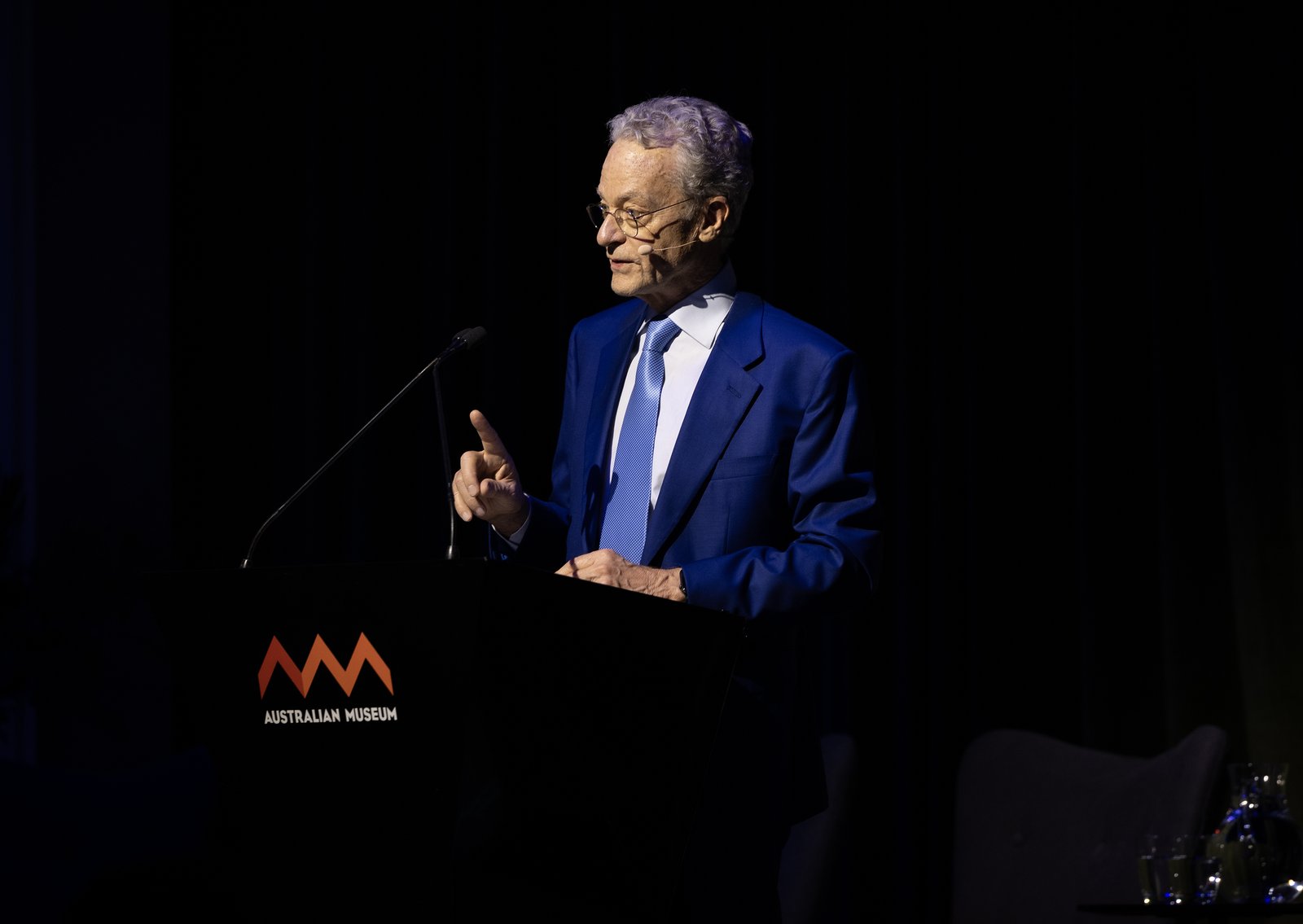
© Australian Museum
The Power of Optimism
When talking about the ocean or climate, I often hear people sigh in resignation.
The problem is too complex. Too entrenched. Or simply too big for one person to make a difference.
I understand that reaction.
But resignation is dangerous.
It is exactly what those who profit from delay, denial, and political paralysis want us to feel.
They are counting on it.
American journalist Anne Applebaum has famously said “pessimism is irresponsible” because it lets people off the hook. There is no inevitable bad ending. How things end will depend on our individual and collective actions.
That requires optimism. Not the naïve optimism that says, “Don’t worry, everything will be fine,” but the harder kind Ernest Shackleton meant when he said, “optimism is true moral courage.” That kind of optimism is not a mood. It is a deliberate, difficult decision to move forward in the face of extreme adversity. It rests on a fundamental belief that the future can be better than the present.
Jane Goodall understood that. She once said humanity stands at the mouth of a very long, very dark tunnel. Right at the end is a little star of hope. We can’t just sit at the mouth of the tunnel and wish that hope will come to us. We have to roll up our sleeves, crawl under, climb over, work our way around all the many, many obstacles
Each person in this room has agency.
How you invest.
What you consume.
Who you vote for.
What stories you tell.
What organizations you join.
Over time, those choices will determine what societies value, what they defend, and what they are willing to save.
Tonight, I hope you leave seeing the ocean differently: not as something abstract, or distant, but as the living system that sustains us all.
When people see the ocean’s beauty — when they dive beneath the surface, or stand at the shore and feel its power — they often move, as I did at Millennium Atoll, from an intellectual understanding of its value to an instinctual one.
And that is what motivates people to act.
We are living at a moment when we know more than any generation before us — and when the choices before us matter more than ever.
We know what is happening. We know what is at stake. And increasingly, we know what to do.
The question is not whether the ocean can be saved.
The question is whether we have the will to act in time.
That choice is now ours to make.
Thank you.
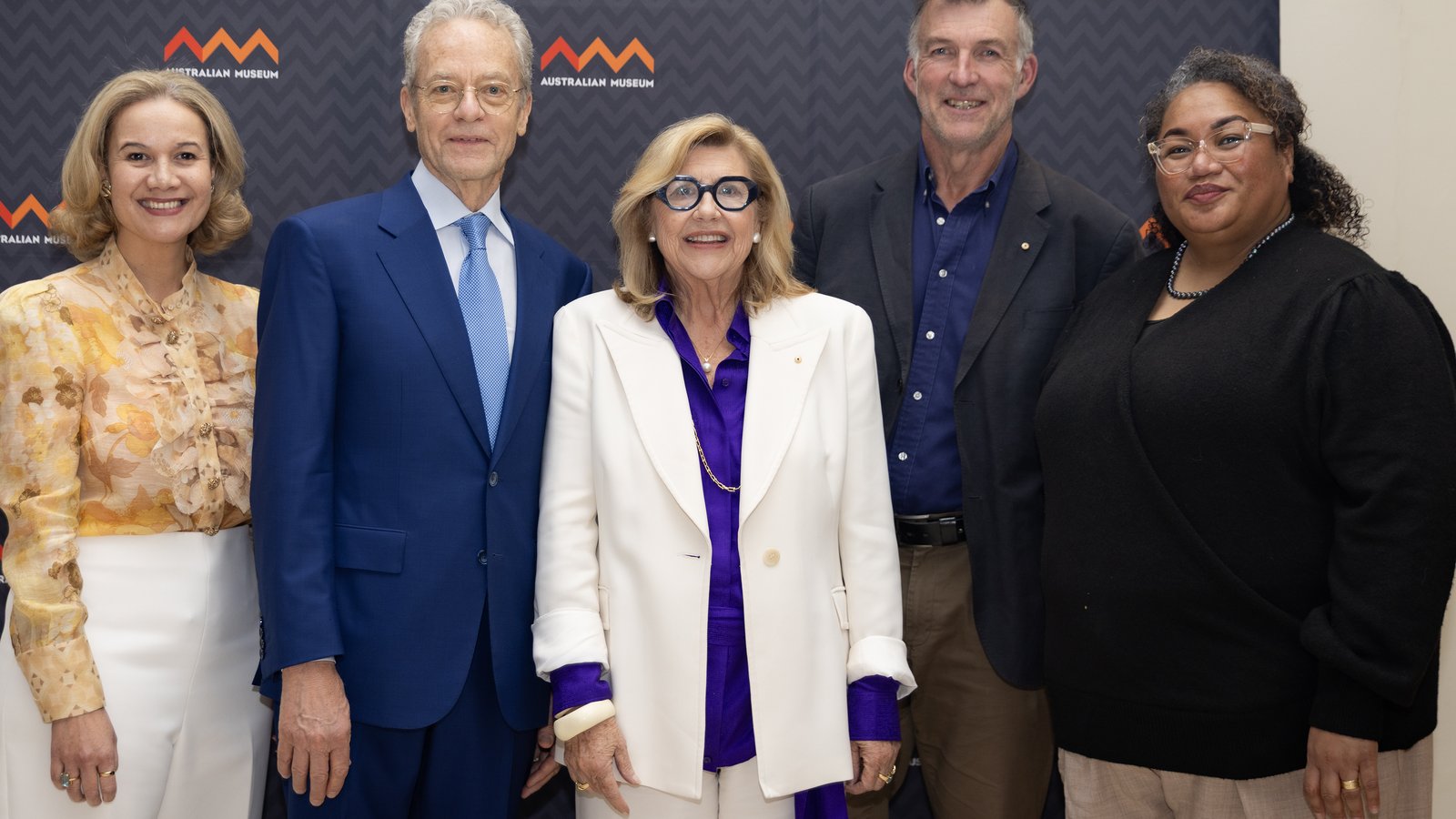
© Australian Museum

© Australian Museum
© Australian Museum

© Australian Museum
Terry Garcia
Terry Garcia was the Executive Vice President and Chief Science and Exploration Officer for the National Geographic Society for seventeen years. In June 2010, he was appointed by President Obama to serve on the National Commission on the BP Deepwater Horizon Oil Spill and Offshore Drilling.
Prior to joining National Geographic, he was the Assistant Secretary of Commerce for Oceans and Atmosphere for the US Department of Commerce, and the Deputy Administrator of the National Oceanic and Atmospheric Administration (NOAA). Terry is currently the President of Exploration Ventures, a company providing strategic advice and counsel to global clients in a range of sectors.

About The Talbot Oration
Named in honour of former Australian Museum Director Professor Frank Talbot, this annual oration celebrates Talbot’s commitment to, and achievements in marine research and environmental studies in Australia and on the global stage.
The Talbot Oration will showcase advances in the field of climate change research and environmental conservation, enabling the public to better understand how responses to the climate challenge determine our future prospects, health, and the sustainability of our natural environment.
